19 Oct

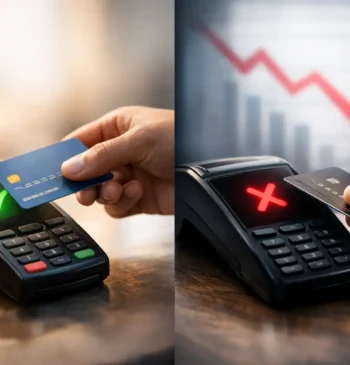
A payment outage rarely announces itself neatly. It may begin as a sudden rise in issuer time-outs, a stream of processor error codes, or a checkout that appears to load but cannot complete authorisation. For merchants processing high transaction volumes, knowing how to implement payment failover is not simply an infrastructure exercise. It is a direct way to protect revenue, preserve customer trust and prevent avoidable abandonment.
Payment failover moves an eligible transaction from an unavailable or underperforming payment route to an alternative route. Done well, it gives customers a reliable way to pay without exposing the business to duplicate charges, unnecessary declines or weaker fraud controls. Done badly, it can create reconciliation problems, increase costs and trigger issuer suspicion.
Start with the payment failures that matter
Not every failed transaction should be rerouted. A genuine insufficient-funds decline will not become approved merely because it reaches another acquirer. Repeating it can frustrate the customer, generate extra fees and make the merchant’s traffic look less trustworthy to issuers.
Failover should instead focus on technical and route-specific failures: gateway time-outs, processor outages, unavailable acquirer endpoints, connection errors and certain ambiguous responses where the transaction status cannot be confirmed immediately. Your routing logic must distinguish these events from hard issuer declines, failed authentication and fraud-rule rejections.
This distinction requires a clear response-code taxonomy. Map each gateway, acquirer and alternative payment method response into practical categories: approved, final decline, retryable technical failure, pending or unknown. The exact mapping will differ by provider, market and payment method, so avoid treating generic error messages as a reliable signal.
Build redundancy before you need it
A second acquirer is only useful when it is operationally ready to accept the same traffic. That means establishing merchant accounts, completing underwriting, configuring supported currencies and card schemes, and agreeing processing capacity in advance. For regulated and high-risk sectors, acquiring options can be narrower, making early contingency planning particularly valuable.
Your secondary route should cover the payment combinations that drive meaningful revenue. Assess it by card brand, currency, customer country, transaction type and business model. A backup route that only supports domestic EUR card payments will not protect a subscription business collecting recurring GBP, USD and multi-currency payments from international customers.
Token portability is equally important. If stored credentials are locked to one processor, moving recurring payments during an outage may be impossible or require a customer to re-enter card details. A payment platform that supports network tokenisation or a token vault designed for multi-provider routing can reduce this dependency while keeping card data exposure controlled.
How to implement payment failover with intelligent rules
The strongest failover design uses a routing hierarchy rather than a single emergency switch. Define a primary route for each transaction profile, then nominate secondary and, where justified, tertiary routes. The choice should reflect expected approval performance, cost, local acquiring capability, settlement needs and risk appetite.
For example, a UK-issued card in GBP may normally use one acquiring route, while a card issued in another European market may perform better through a different local acquirer. If the preferred route becomes unavailable, the orchestration layer can move the transaction to the next eligible route. This approach protects continuity without abandoning the commercial advantages of optimised routing.
Set clear eligibility conditions. A transaction should fail over only when the original response indicates a technical problem and the alternative route supports the relevant card scheme, currency, merchant category and authentication requirements. Apply limits to the number of attempts. In most cases, one controlled failover attempt is safer than sending the same payment through several providers.
Timing matters. A customer should not wait through multiple long time-outs before receiving a result. Configure practical time-out thresholds and monitor real performance, not just contractual service levels. Some merchants use circuit-breaker logic: when error rates on a route exceed a defined threshold, new eligible traffic is temporarily diverted until the route recovers.
Prevent duplicate charges and operational confusion
The most difficult failover scenario is an unknown outcome. A request may time out after the issuer has approved it, but before your system receives confirmation. Retrying immediately through a second acquirer can lead to two successful authorisations or captures.
Use a unique merchant transaction reference and idempotency controls for every payment attempt. Your payment platform should retain the original attempt, its route, timestamps and status checks, then associate any retry with the same customer order. Where a result is uncertain, query the original processor before sending another authorisation if the response window allows it.
Keep authorisation and capture logic consistent across routes. If you authorise on one acquirer and capture on another, settlement and reconciliation become unnecessarily complex and may not be supported. The usual approach is to keep the lifecycle of an approved transaction with the acquirer that approved it, while using failover only for transactions that did not complete.
Webhook handling deserves the same discipline. Process notifications asynchronously, verify their authenticity and design for delayed or duplicated events. A late approval webhook from the primary processor must not be mistaken for a new order after the fallback route has already responded.
Preserve security and authentication controls
Failover must not become a route around security. Each route needs equivalent PCI DSS controls, secure payment fields or hosted checkout options, and appropriate data handling. If card data passes through your own environment, the compliance burden increases considerably; tokenised integrations can keep the payment flow more controlled.
For card payments in Europe, ensure each route supports the required 3D Secure v2 flows and your chosen approach to exemptions. Authentication data, transaction values and merchant information must pass correctly to the fallback route. Otherwise, a technically successful retry may create unnecessary authentication friction or result in a decline.
Fraud screening should remain consistent, but it does not have to be identical. Different acquirers have distinct risk tolerances, and high-risk merchants may need route-specific velocity limits, country rules or fraud thresholds. The aim is controlled flexibility: maintain your core risk policy while recognising the rules needed to keep each acquiring relationship healthy.
Test failover as a live commercial process
A routing diagram is not proof that failover works. Test it with each relevant payment method and transaction type, including one-off card purchases, recurring rebills, refunds, pre-authorisations and captures. Include local payment methods where they form a material part of conversion, as their status models and retry rules can differ from cards.
A useful test programme should cover at least these four scenarios:
- A clear technical decline on the primary route that is approved on the backup route.
- A time-out or unknown status where the original transaction later returns an approval.
- A 3D Secure challenge and a frictionless authentication flow after rerouting.
- A controlled return to the primary route once service and approval performance recover.
Test in a non-production environment where possible, then run carefully governed production tests with low values and defined monitoring. Reconcile every attempt across the checkout, orchestration layer, acquirer reports and settlement records. The goal is not merely to see an approval, but to prove that the customer is charged once, the order status is correct and finance teams can account for the payment.
Monitor approval rates, not only uptime
Processor uptime can look healthy while approval performance deteriorates for a specific issuer country, card scheme or currency. Track approval rate, technical error rate, authentication completion, response latency, duplicate-attempt rate and cost by route. Segment the data by market and payment type so that a local issue does not disappear inside an attractive global average.
Define who can activate manual overrides, who communicates with acquirers and who owns customer-service messaging during a material incident. Automated routing handles speed, but operational ownership handles the exceptions. Payment, technical, finance and risk teams should all know what evidence is required before a route is disabled or restored.
AllSecure supports merchants with multi-provider payment infrastructure, configurable routing and hands-on integration expertise, helping teams design contingency flows that match their markets, risk profile and growth plans.
The best failover strategy is deliberately quiet. Customers should experience a payment that works, while your teams retain a clear audit trail, controlled risk exposure and the freedom to keep trading when one route cannot.
Related Articles