03 Sep
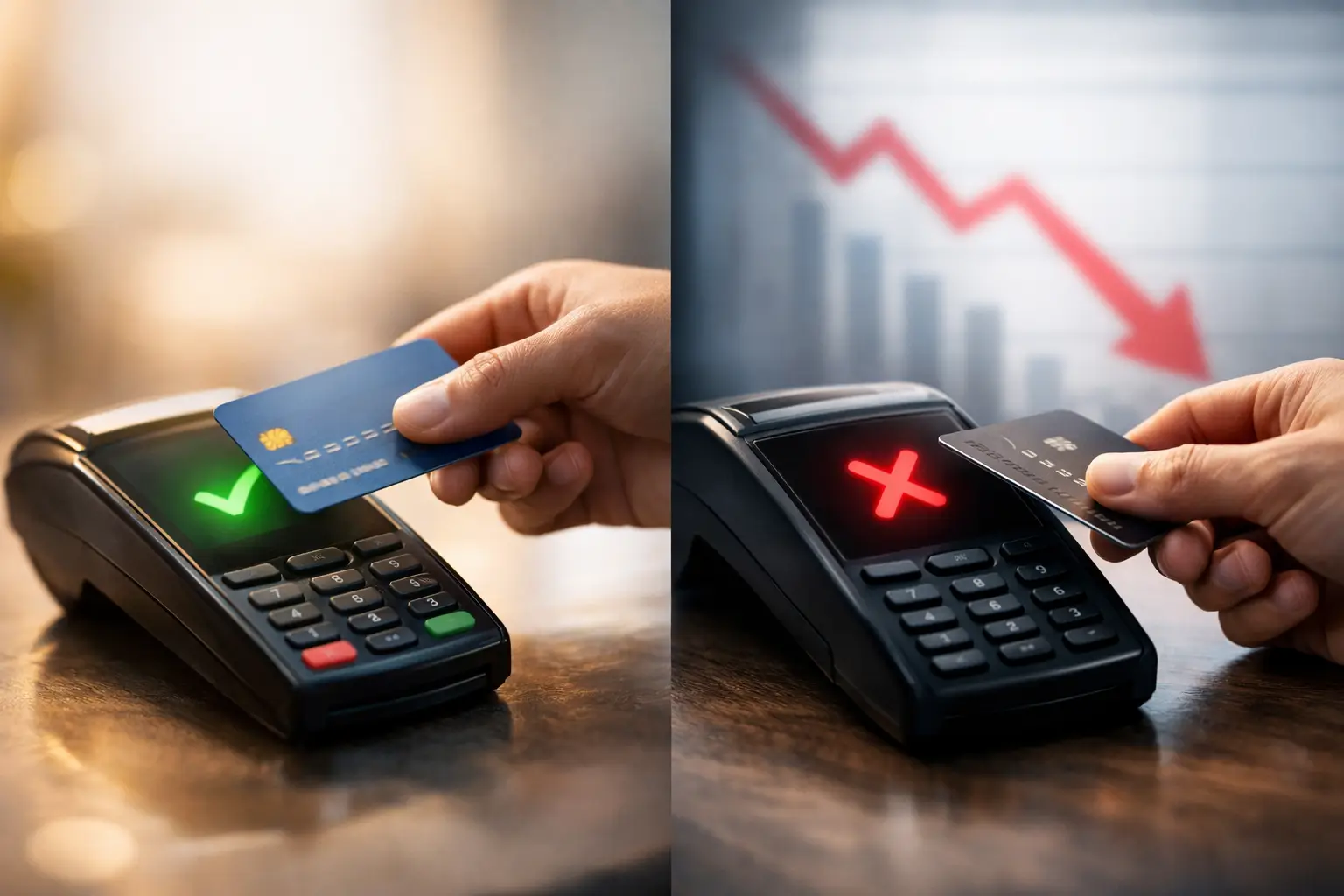
A customer reaches the final checkout step, submits their card details and receives a decline message. For the merchant, that single outcome can mean two very different things. Understanding soft declines versus hard declines determines whether a payment should be recovered, rerouted, retried later or stopped before it creates unnecessary cost, customer frustration or fraud exposure.
For businesses processing at scale, declines are not simply a payment operations metric. They affect conversion, lifetime value, support volumes, subscription retention and acquiring performance. The right response starts with recognising that a decline code is useful evidence, not always a final verdict.
What is a soft decline?
A soft decline is a transaction that has been refused for a reason that may be temporary, correctable or dependent on how the payment is processed. The customer may have sufficient funds and a valid card, but the transaction cannot be approved in its current form.
Common examples include a temporary issuer restriction, an online spending limit, a failed or missing Strong Customer Authentication step, a timeout, or an issuer request to retry through a different authentication flow. A cardholder may also need to approve a payment in their banking app before the issuer will authorise it.
In subscription commerce, soft declines are particularly significant. A card can be valid and active, yet a scheduled renewal fails because the issuer has applied a temporary control or the cardholder has reached a limit. Treating every such event as a lost customer leaves recoverable revenue on the table.
A soft decline does not mean every retry will work. Repeated attempts made too quickly, or with no change to the transaction, can increase issuer suspicion, create avoidable processing costs and damage the merchant’s approval profile. Recovery needs a controlled strategy rather than blind persistence.
What is a hard decline?
A hard decline indicates that the transaction should not be retried using the same card and payment details. The underlying reason is generally permanent or materially unlikely to change without action from the cardholder.
Typical hard-decline scenarios include a lost or stolen card, a closed account, an invalid card number, a card reported as fraudulent, or an issuer instruction not to honour the transaction. In these cases, further authorisation attempts are unlikely to generate revenue and may introduce risk.
For a one-off purchase, the appropriate next step is usually to ask the customer to use another payment method. For recurring billing, the merchant should prompt the customer to update their details through a secure account or payment link. Network tokenisation and card account updater services can also reduce avoidable failures when a card has expired or been replaced, depending on the card scheme, issuer and available service configuration.
Soft declines versus hard declines: the commercial difference
The distinction matters because the correct operational response is opposite. Soft declines call for measured recovery. Hard declines call for suppression, alternative payment options and, where appropriate, fraud review.
A recovery process for a soft decline might involve a single retry after a defined interval, a 3D Secure v2 challenge, an alternative acquirer route, or a request for the customer to confirm the transaction. A hard decline should remove the card from automated retry logic and prevent further authorisation attempts against the same credential.
This is not always as simple as reading one response label. Acquirers, card schemes and issuers can describe outcomes differently, and generic response messages may conceal a more specific issuer reason. Payment teams should retain the raw processor response, scheme data and transaction context, then map them into clear internal categories. That creates consistent decisions across checkout, recurring payments, customer support and finance operations.
A useful classification model considers three questions: can the customer reasonably resolve the issue, is time likely to change the outcome, and would another attempt increase risk or cost? If the answer suggests a temporary condition, the payment may belong in a soft-decline recovery flow. If the issuer has clearly rejected the credential or transaction, it belongs in a hard-decline flow.
Why legitimate payments are declined
Declines are often associated with insufficient funds or fraud, but approval decisions are more complex. Issuers assess transaction value, merchant category, geography, customer behaviour, authentication results, device signals and their own risk rules. A legitimate purchase can be declined because it looks unusual in a particular context.
Cross-border commerce illustrates the challenge. A customer may use a card issued in one market, make a purchase from another, pay in a different currency and complete the transaction on a mobile device. Each element can influence the issuer’s decision. High-risk and regulated sectors may face additional scrutiny, especially where transaction patterns resemble account testing, bonus abuse or unauthorised use.
Technical factors matter too. Incomplete billing data, incorrect merchant descriptor configuration, an unsuitable transaction type, weak authentication handling or an acquirer route with limited issuer performance can all reduce approval rates. A decline rate should therefore be investigated as a payment-flow issue, not assigned automatically to customer behaviour.
Build a controlled soft-decline recovery strategy
Effective recovery combines payment data, sensible timing and a customer experience that does not create more abandonment. The best approach depends on whether the transaction is customer-initiated or merchant-initiated.
At checkout: resolve friction while the customer is present
For customer-initiated payments, act on the decline reason in real time. If the issuer requires authentication, initiate the appropriate 3D Secure v2 flow rather than presenting a vague error. If the payment fails after authentication or receives a technical soft decline, offer a clear path to retry once or select another method.
The checkout message should be neutral and practical. Avoid telling the customer that their card has been rejected permanently when the issuer may simply need confirmation. A message such as “Your bank could not approve this payment. Please try again or use a different payment method” provides direction without exposing sensitive risk logic.
Alternative payment methods can be valuable here. Digital wallets, bank-based methods and local payment options may reduce friction for customers who do not want to repeat card authentication. The right mix depends on the markets served, customer preferences and the merchant’s risk model.
For recurring payments: use intelligent retries
Merchant-initiated subscription and instalment payments need a different treatment. The customer is not present to complete an authentication challenge, so timing and retry limits become central.
A well-designed dunning strategy does not retry every decline at the same interval. It uses the response reason, payment amount, billing cycle and historical issuer behaviour to determine whether and when to make another attempt. A temporary “insufficient funds” response may perform better after payday, while a technical timeout may justify a carefully controlled earlier retry. A lost-card response should stop automated attempts immediately.
Keep retry schedules transparent in customer communications. Where a payment remains unpaid, send a prompt that explains the action required and gives the customer a secure way to update their payment method. This protects revenue while reducing involuntary churn.
Improve approvals before declines occur
The strongest decline strategy prevents avoidable declines at the point of authorisation. That begins with clean payment data and a reliable integration. Hosted payment fields can reduce the risk of formatting errors while keeping sensitive card data out of the merchant environment. Clear webhooks and transaction-status handling prevent a timeout or interrupted customer session from being mistaken for a final payment failure.
Authentication should be configured to support both compliance and conversion. 3D Secure v2 can provide richer data to issuers and apply frictionless authentication where risk is low, but configuration must be aligned with the merchant’s transaction types, exemption strategy and markets. Poorly implemented authentication can create unnecessary challenge rates and checkout abandonment.
Acquirer selection and routing also influence outcomes. No acquirer performs equally across every issuer, territory, card type or vertical. Multi-acquirer payment orchestration allows merchants to build approved routing rules, use a secondary route where appropriate and avoid concentration on a single processing path. It should be governed carefully: routing must respect scheme rules, customer consent, risk controls and any restrictions set by acquiring partners.
For complex sectors, fraud prevention and conversion cannot be managed in isolation. Rules that are too strict can block valuable customers. Rules that are too loose can increase chargebacks, fraud losses and issuer distrust. Real-time monitoring, device and behavioural signals, velocity controls and tailored review processes help strike the right balance.
Measure the signals that lead to action
An overall decline rate is a useful headline, but it is not enough to improve performance. Separate issuer declines, acquirer declines, technical failures, authentication failures and suspected fraud outcomes. Then segment the results by country, issuer, card brand, transaction type, payment method, device, currency and acquiring route.
Payment teams should also track soft-decline recovery rate, hard-decline suppression rate, retry success by interval, challenge completion rate and post-decline customer abandonment. These measures reveal whether a recovery strategy is generating incremental approvals or simply adding cost and friction.
Review the data with acquirers and payment partners regularly. A sudden change in a particular issuer’s approval rate may point to a routing issue, an authentication configuration change or a new issuer risk pattern. Fast diagnosis is especially valuable during peak trading periods, product launches and major subscription renewal cycles.
A declined payment is not always lost revenue, but it is always a signal. Classify it accurately, give legitimate customers a safe route to complete their purchase, and stop unproductive attempts before they affect risk and cost. With the right payment infrastructure and operational discipline, decline management becomes a practical route to stronger conversion and more dependable growth.
Related Articles