12 Sep
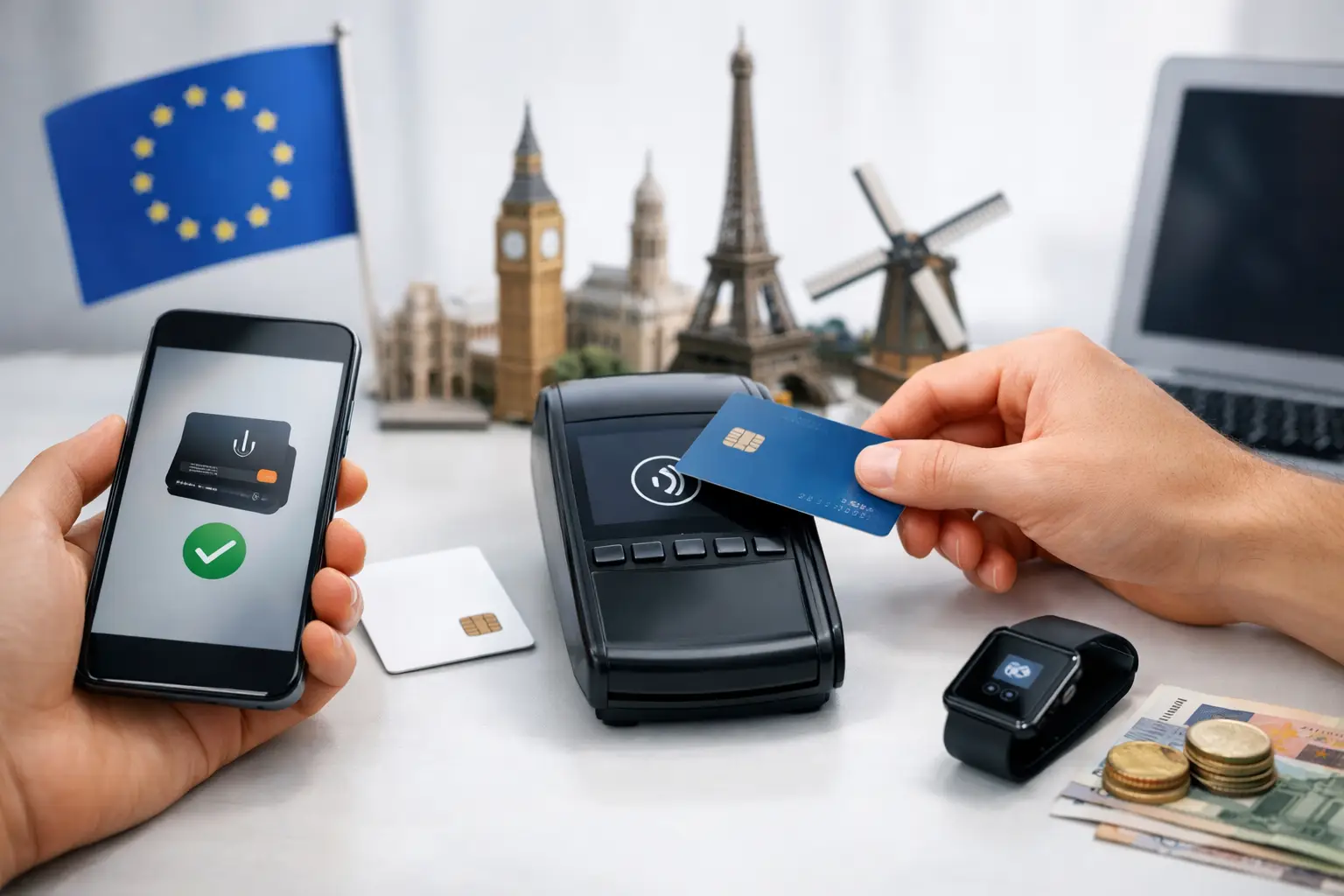
A shopper in the Netherlands may expect iDEAL. A German customer may prefer PayPal or direct bank payment. In France, cards remain central, while digital wallets can influence mobile conversion across multiple markets. Europe payment methods are not a single checkout decision: they are a commercial, technical and risk-management decision that varies by country, customer segment and transaction type.
For merchants expanding across borders, accepting cards is essential but rarely sufficient. The strongest payment strategy gives customers familiar ways to pay while maintaining reliable acquiring, effective fraud controls and a checkout flow that does not create unnecessary abandonment.
Europe payment methods are local decisions
Europe has a shared regulatory direction in areas such as Strong Customer Authentication, but consumer behaviour is still deeply local. Payment preferences are shaped by banking habits, mobile adoption, trust in domestic schemes and the type of purchase being made.
Cards, particularly Visa and Mastercard, provide broad coverage and should form the foundation of most online payment stacks. They support international customers, subscriptions, refunds and established dispute processes. However, card-only checkout can leave conversion on the table in markets where account-to-account payments, wallets or domestic payment schemes are more familiar.
For example, iDEAL is a prominent choice for Dutch consumers, while Bancontact has strong recognition in Belgium. Germany has a long history of bank-based payments and invoice-style purchasing preferences. In the Nordic markets, wallet and mobile-led payment experiences are especially influential. These patterns do not mean every merchant needs every method. They do mean that a one-size-fits-all checkout is a poor assumption.
The right mix depends on where revenue comes from, where the business intends to grow and how customers pay for the specific product. A travel merchant selling high-value bookings has different requirements from a digital subscription service collecting low-value recurring payments. Regulated and high-risk sectors must also assess whether an alternative payment method supports their business model, underwriting profile and refund processes.
Build the payment mix around conversion and control
Adding payment methods without a clear strategy can make checkout harder to manage. Each method introduces operational work: settlement timelines, refund rules, reconciliation formats, customer support questions and risk exposure. The objective is not maximum choice. It is relevant choice, presented at the right moment.
A practical starting point is to examine payment data by country, device, currency, issuer response and customer type. If card declines are high in a target market, the answer may be better acquiring coverage or smarter transaction routing rather than another checkout option. If customers repeatedly leave after reaching the payment page, a locally recognised method may help reduce hesitation.
Merchants should prioritise methods that meet at least one of these commercial needs:
- They are widely used by customers in a priority market.
- They improve mobile checkout by reducing manual card entry.
- They offer a credible route to higher approval rates or lower abandonment.
- They support the merchant’s refund, recurring billing and reconciliation requirements.
- They are compatible with the sector’s risk, compliance and acquiring position.
This approach prevents payment-method sprawl. It also makes it easier to measure whether a new option is producing incremental revenue rather than simply moving existing customers away from cards.
Cards still need active optimisation
Card acceptance is not a set-and-forget capability. Approval rates can vary according to the acquirer, card scheme, issuer, transaction currency, authentication result and routing logic. A merchant with customers across several European markets may benefit from more than one acquiring relationship, particularly where local acquiring improves issuer recognition or authorisation performance.
Network tokenisation can reduce friction for stored credentials by replacing sensitive card data with a token designed for payment processing. Account updater services and intelligent retry rules can help protect recurring revenue when cards expire or an initial subscription renewal fails. These features matter most for membership, telecoms, digital services and other recurring-payment models, where involuntary churn can quietly erode margin.
Hosted payment fields or a hosted checkout can reduce PCI scope while keeping the payment experience aligned with the merchant’s brand. API-led integrations offer more control for businesses that need bespoke checkout logic, payment orchestration or deeply integrated mobile journeys. Neither route is universally better. The appropriate choice depends on internal technical capacity, time to market and the level of control required.
Bank payments and wallets change the checkout experience
Bank-based methods can offer a trusted, familiar route for local customers. They may also have a different cost structure and dispute model from cards. Yet they are not automatically better for every use case. Some have limited support for recurring collections, delayed confirmation, different refund expectations or a checkout hand-off that affects the customer journey.
Digital wallets can make mobile payment faster by reducing form completion and using device-level authentication. Their value is particularly clear where a merchant has strong mobile traffic or customers who return frequently. Before implementation, merchants should assess wallet availability by territory, whether tokenised credentials are supported, and how wallet transactions are reported and reconciled.
Buy now, pay later options can support conversion for suitable retail categories and higher-consideration purchases. They also require care. Eligibility, consumer-credit rules, merchant fees and brand fit should be evaluated before placing them prominently in checkout. For businesses selling age-restricted, regulated or high-risk services, availability may be restricted altogether.
Security must support, not interrupt, payment acceptance
PSD2 Strong Customer Authentication has changed how many online payments are approved in Europe. 3D Secure v2 allows richer transaction data to be shared with issuers and is designed to make risk-based, low-friction authentication more achievable. But authentication performance depends on configuration and data quality, not simply on switching 3D Secure on.
Merchants should send complete, accurate transaction data wherever possible and monitor frictionless versus challenged authentication rates. They should also understand when exemptions may apply and how their acquirer and issuers handle them. An exemption is not a guarantee of approval, and an incorrectly configured flow can create avoidable declines.
Fraud prevention needs the same balanced approach. Excessively strict rules may block legitimate customers, particularly when users travel, use VPNs or make cross-border purchases. Weak controls invite fraud, chargebacks and acquiring pressure. Effective risk management combines velocity controls, device and behavioural signals, blacklists and whitelists, transaction scoring, 3D Secure strategy and ongoing review of chargeback reason codes.
For high-risk merchants, this discipline is commercially critical. Payment partners and acquirers will assess fraud ratios, dispute rates, customer-service practices and the clarity of billing descriptors. A payment stack that improves approval rates but creates an unmanaged chargeback problem is not delivering sustainable growth.
Use orchestration to keep expansion manageable
As payment coverage grows, a single processor connection can become a constraint. Acquirer outages, regional decline patterns, changing risk appetite and local method requirements all affect payment performance. Payment orchestration gives merchants a way to connect multiple providers and apply routing rules without rebuilding their entire checkout each time.
Rules can be based on country, currency, card type, transaction value, payment method, risk score or historical approval performance. A sensible routing strategy does not blindly chase the lowest processing cost. It balances approval uplift, reliability, fraud outcomes, settlement needs and the operational cost of managing each provider.
Real-time reporting is essential here. Teams should be able to see authorisation rates, soft and hard declines, authentication outcomes, chargeback trends and method adoption by market. Without this visibility, payment decisions are based on anecdote rather than evidence.
AllSecure combines payment gateway technology, acquiring access, alternative payment methods and configurable risk controls so merchants can build this kind of tailored payment infrastructure without treating every new market as a separate technical project.
Launch country by country, then optimise
A phased rollout is usually safer than adding every available method at once. Start with core card acceptance, appropriate local methods and clear monitoring for a priority market. Test checkout presentation, authentication flows, refund handling, support processes and reconciliation before expanding further.
Review results after launch. Look beyond headline conversion to payment success by method, issuer decline codes, fraud rates, time to settlement and repeat-purchase behaviour. Sometimes a popular local method is the right addition; sometimes the bigger gain comes from a new acquirer route, cleaner transaction data or a simpler checkout page.
The best European payment strategy is never static. Customer preference, regulation, issuer behaviour and acquiring conditions change. Keep the payment stack flexible enough to respond, and each new market can become a controlled opportunity for higher conversion rather than another source of operational risk.
Related Articles