24 Oct
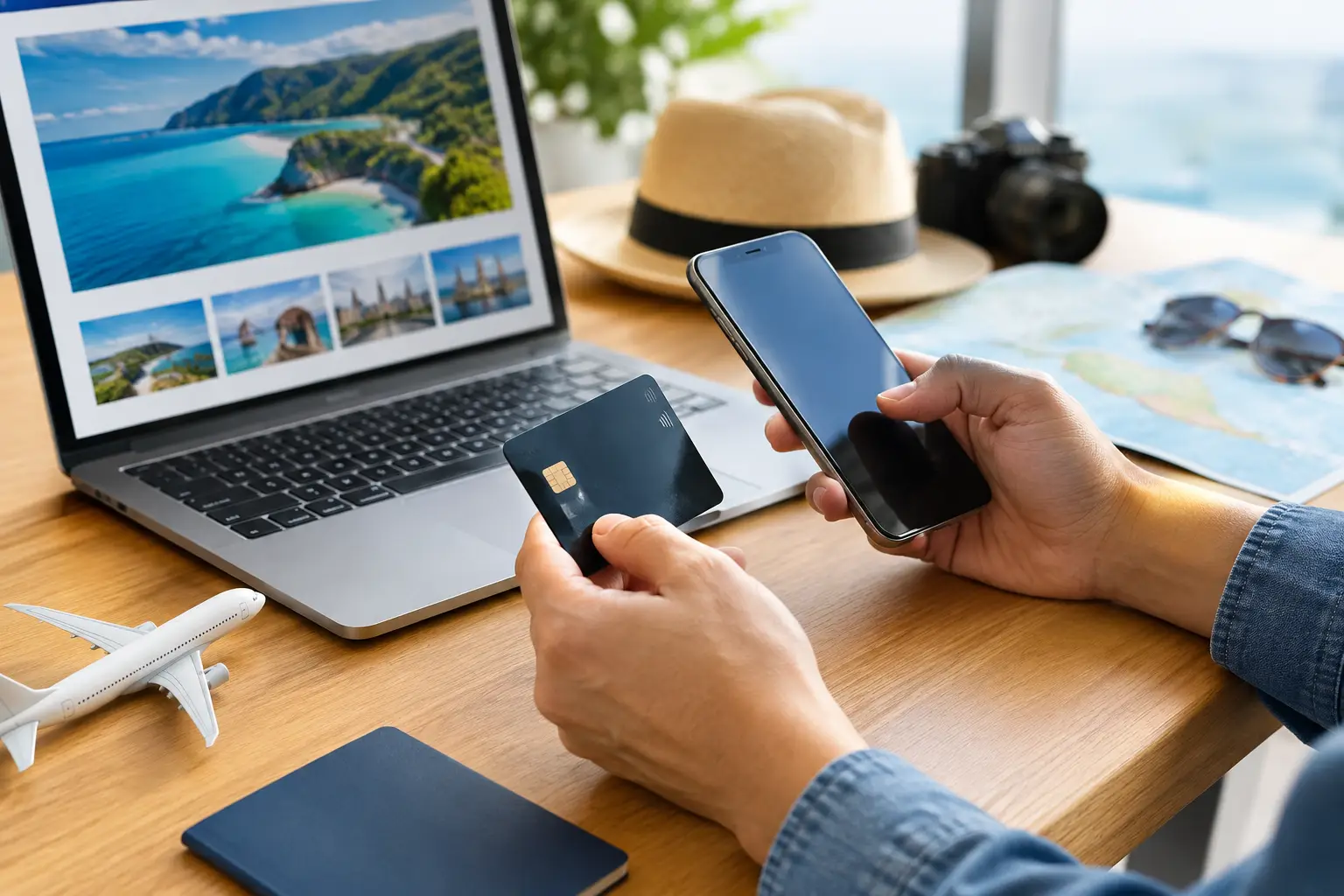
A traveller can compare fares in pounds, book from a mobile in another time zone and expect confirmation within seconds. If the checkout does not offer a trusted way to pay, or declines a legitimate transaction, the booking often goes elsewhere. For travel merchants, selecting the best payment methods for travel is therefore a conversion, revenue-protection and customer-service decision – not simply a checkout feature.
Travel payments are unusually demanding. Booking values can be high, fulfilment may happen weeks or months after purchase, cancellations are common, and customers book across borders with deeply ingrained local payment preferences. The right payment mix must make it easy for genuine customers to complete a purchase while giving the merchant control over fraud, chargebacks, currencies and processing costs.
What makes travel payments different?
A typical e-commerce transaction is completed and fulfilled quickly. Travel operates on a longer and less predictable timeline. A customer may reserve a hotel in January for a stay in August, alter the booking twice, add extras later and request a partial refund after departure. Airlines, online travel agencies, tour operators, accommodation providers and car-hire firms all need payment flows that can accommodate this reality.
The sector also has a high cross-border element. A UK customer may pay a European travel business in sterling for a hotel priced in euros, using a card issued by a bank in another country. Each extra point of friction – an unfamiliar payment page, an avoidable foreign-exchange surprise or a failed authentication step – can reduce conversion.
This is why there is no single best method for every travel merchant. The strongest approach combines globally recognised payment types with the local methods customers expect in each source market, then manages them through a payment infrastructure designed for reliability and control.
The best payment methods for travel bookings
Cards remain the essential payment rail
Visa, Mastercard and other major card schemes should form the foundation of most travel checkouts. Cards are familiar, support high-value transactions and work well for international customers. They also allow merchants to manage authorisations, captures, refunds, recurring charges for agreed booking plans and deposits through established operational processes.
However, card acceptance alone is not enough. Travel businesses need intelligent routing across acquiring partners, local currency acceptance and strong approval-rate management. A card decline is not always a lack of funds. It may result from issuer risk rules, cross-border routing, an authentication failure or an acquiring configuration that is poorly matched to the transaction.
Network tokenisation can reduce exposure to card data and improve continuity when a card is replaced or expires. For merchants that hold a payment credential to collect a balance, process a no-show charge or take an agreed instalment, tokenised card-on-file payments are particularly valuable.
Digital wallets reduce mobile friction
Digital wallets are an increasingly important choice for travellers, especially when bookings are made on mobile devices. They reduce manual entry, use device-level authentication and give customers an immediate sense of familiarity. That can be decisive when a traveller is booking a transfer, attraction or same-day room under time pressure.
Wallets are not a replacement for cards – they are often a more convenient way to present card credentials. Their commercial value lies in faster checkout completion and a lower risk of typing errors. Merchants should assess wallet performance by device type, market and booking value rather than assuming adoption will be uniform across every audience.
Bank payments can improve economics and trust
Account-to-account payment methods can be highly relevant for travel, particularly for larger bookings, group travel and customers who prefer to pay directly from their bank account. In markets where bank-based checkout methods are well established, they can deliver a trusted local experience and may offer an attractive cost profile compared with cards.
The trade-off is operational. Merchants must understand confirmation timing, refund handling, reconciliation and consumer protection expectations for each method. A payment that appears economical at checkout can become expensive if it creates manual work or uncertain booking confirmation. Real-time payment confirmation and clear integration with the booking platform are therefore central requirements.
Buy now, pay later suits selected booking journeys
Buy now, pay later can help customers spread the cost of holidays, accommodation packages or higher-value experiences. For merchants, it can support conversion where price sensitivity is high and payment flexibility is a meaningful purchase driver.
It is not appropriate for every travel product. Availability, settlement terms, customer eligibility and cancellation processes must be assessed carefully. A merchant also needs clarity on who manages refunds when an itinerary changes. Used selectively, it can be a strong commercial option; added without operational planning, it can complicate the customer journey.
Local payment methods win regional demand
Local payment methods are often the difference between being present in a market and genuinely converting in it. Consumers may prefer direct bank transfer tools, local wallets, prepaid options or invoice-style payment arrangements that are less familiar outside their home market.
A travel merchant does not need to add every available option. Start with the countries that generate meaningful traffic or have strategic growth potential. Review checkout abandonment, payment-method selection, approval rates and customer-service contacts to identify where a local method would solve a real commercial problem.
Build payment choice around the booking journey
The best checkout is not the one with the longest list of logos. It is the one that presents the most relevant options without overwhelming the customer. A traveller booking an urgent airport transfer has different needs from a family paying a deposit for a summer holiday.
For instant-confirmation products, prioritise methods that give immediate authorisation or confirmation. For deposits and scheduled balances, ensure the payment flow captures customer consent clearly and stores credentials securely for subsequent charges. For hotels and car hire, pre-authorisation and incremental authorisation capabilities may be more relevant than a simple one-time payment.
Currency also matters. Presenting prices in a customer’s preferred currency can reduce uncertainty and increase confidence, but merchants should be transparent about exchange rates and avoid creating confusion between displayed, charged and settled amounts. Multi-currency acceptance should support the customer experience while preserving clear financial reconciliation for the business.
Fraud control must protect conversion, not obstruct it
Travel is a frequent target for fraud because bookings can be resold, consumed quickly or made at high values. Yet excessive decline rules can reject legitimate customers who are booking internationally, using a corporate card or making an unusual purchase before a trip.
A layered approach is more effective than treating every transaction alike. 3D Secure v2 can provide additional authentication where required, while risk scoring, velocity checks, device data and configurable rules can identify suspicious patterns. The aim is to step up verification for higher-risk activity while allowing low-risk, recognised customers to complete payment with minimal interruption.
Merchants should also distinguish between fraud prevention and chargeback management. Clear booking terms, accurate descriptors, prompt confirmations, accessible cancellation processes and well-maintained transaction evidence all help reduce disputes after the payment is accepted. For travel, evidence may include confirmation records, customer communications, itinerary changes and proof of service delivery.
Choose infrastructure that can adapt
Travel businesses rarely stand still. They launch new routes, enter new source markets, add ancillary services and face seasonal demand spikes. A payment setup that depends on one acquirer, one method or one rigid integration can become a constraint when performance changes.
Payment orchestration gives merchants more control by connecting multiple payment service providers, acquirers and alternative payment methods through a single platform. It enables routing decisions based on geography, currency, transaction type, approval performance or risk profile. If one route underperforms, merchants have the ability to redirect eligible transactions rather than accepting lost revenue as inevitable.
The underlying platform should also support secure hosted payment fields, APIs, webhooks, recurring billing functions and detailed reporting. PCI DSS Level 1 infrastructure reduces the burden of handling sensitive card data directly, while real-time monitoring helps payment and operations teams act quickly when approval rates or fraud patterns shift.
Measure the payment methods that actually perform
Payment-method strategy should be reviewed as a commercial discipline, not set once during implementation. Track authorisation rates by country, issuer, currency, device and method. Compare checkout conversion before and after adding an option, then assess its effect on refunds, fraud losses, chargebacks and support workload.
A method with lower processing fees is not automatically the better option if customers rarely choose it or if it introduces reconciliation problems. Equally, a higher-cost method may justify itself if it converts a valuable audience that would otherwise abandon the booking. The relevant metric is profitable completed bookings, not the headline cost of a transaction.
For complex travel payment environments, hands-on support can make a material difference. The right payments partner helps merchants select suitable acquirers, configure authentication and risk rules, add regional methods and monitor performance as demand evolves. AllSecure combines this consultative approach with gateway, orchestration and acquiring capabilities built for merchants that need dependable global payment acceptance.
The most effective travel checkout does not ask customers to adapt to the merchant’s payment limitations. It gives them a secure, familiar and proportionate way to pay, while giving the business the controls needed to convert more bookings with confidence.
Related Articles