25 Aug
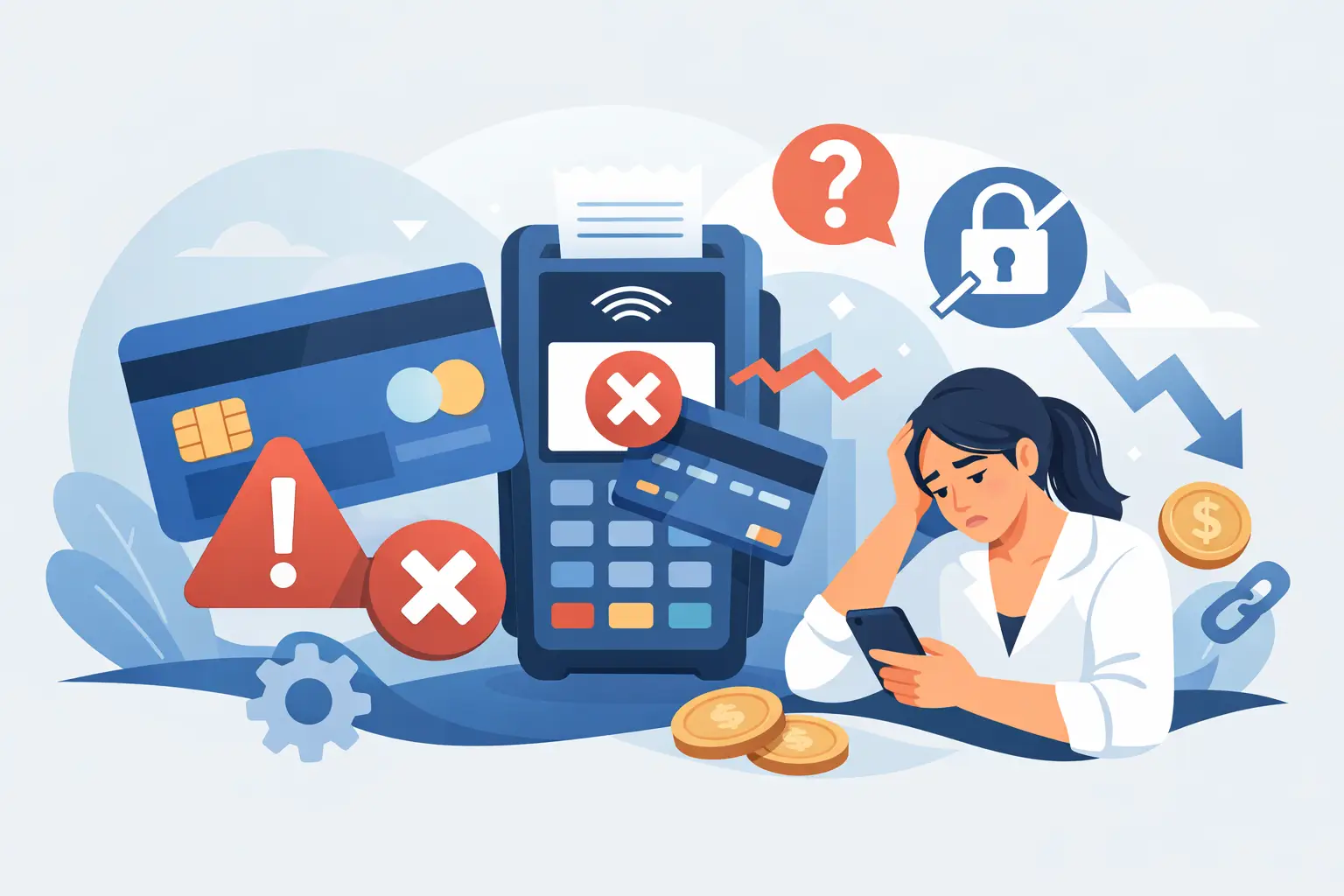
A customer reaches the final step of checkout, submits a valid-looking card and receives a decline. For a merchant, the immediate question is simple: why do card payments fail when the customer has shown clear intent to buy? The useful answer is rarely a single error code. A declined transaction can reflect an issuer decision, missing data, fraud controls, an acquirer limitation or a technical problem in the payment flow.
Treating every decline as fraud, or simply asking customers to try again, leaves revenue on the table. Merchants need a clearer view of where payment failures occur, what can be recovered and which changes improve approvals without weakening risk controls.
Why Do Card Payments Fail During Checkout?
A card payment passes through several parties in seconds: the customer, merchant checkout, payment gateway, acquirer, card scheme and issuing bank. Any one of them can stop the transaction. The response shown to the customer may be broad, while the underlying cause is highly specific.
Some declines are final and appropriate. A stolen card, an expired card or an account with insufficient funds should not be forced through. Others are recoverable. A customer may fail an authentication challenge, enter an incorrect billing detail, exceed a temporary issuer limit or encounter a transaction routed to an acquirer that is not the best fit for that card or market.
The commercial objective is not to pursue a 100% approval rate. That would create unacceptable fraud and chargeback exposure. The objective is to separate legitimate payments that can be approved from transactions that should be declined, then make the legitimate path as straightforward as possible.
Issuer declines and customer account issues
The issuing bank has the final say on many authorisation requests. It may decline because the account lacks available funds, the card is expired or blocked, the cardholder has entered the wrong security code, or the transaction exceeds a card, daily or online spending limit.
Issuers also use their own risk models. A payment can be declined when its amount, location, merchant category, device or purchase pattern appears unusual for that cardholder. This is common in cross-border commerce, recurring subscriptions, travel bookings and higher-risk sectors. The merchant may have done nothing wrong, yet the issuer may still require stronger evidence before approving the payment.
Authentication and 3D Secure friction
Strong Customer Authentication is designed to protect cardholders and merchants, but an incomplete or poorly handled challenge can reduce conversion. Customers may abandon a checkout after being redirected, fail to receive a one-time passcode or encounter an authentication method that does not work well on a mobile device.
3D Secure v2 supports richer transaction data and can enable frictionless authentication where the issuer is confident enough to approve without challenging the customer. However, frictionless approval depends on data quality, issuer policy and the transaction profile. Sending incomplete customer, device or delivery information can make a challenge more likely, while indiscriminate exemption use can raise fraud risk or lead to issuer rejection.
Incorrect, incomplete or inconsistent payment data
A payment request may fail because card details, expiry dates, CVV values, billing addresses or customer names have been entered incorrectly. Technical data can cause the same result. An incorrectly formatted amount, currency mismatch, duplicated transaction reference or a failed token request can prevent authorisation before the issuer even assesses the purchase.
Subscription merchants face an additional challenge. Cards expire, are replaced and can be restricted by the issuer between renewal dates. Network tokenisation and account updater services can reduce avoidable recurring-payment failures, but they need to be configured around the merchant’s payment model and supported acquiring routes.
The Payment Infrastructure Causes Merchants Can Control
Not every payment failure is a customer problem. Approval rates are shaped by the quality of the gateway integration, acquirer coverage, routing logic and real-time operational monitoring.
An acquirer may have restrictions on merchant category codes, territories, transaction values, card types or currencies. This is particularly relevant for regulated, high-risk and international businesses. A routing setup that performs well for domestic debit cards may not be the right route for premium credit cards, cards issued overseas or transactions from a different customer segment.
Technical availability matters too. Time-outs, API errors, duplicate requests and delayed webhook handling can create failed or uncertain payment states. If the customer retries after a time-out, the merchant also needs protection against accidental duplicate charges. Clear idempotency controls, reliable status updates and properly designed retry logic are operational essentials, not merely developer details.
Common Decline Patterns Worth Investigating
Payment teams should analyse declines by issuer country, card scheme, currency, device, transaction type, acquirer and response code. Aggregate approval rates can conceal a serious weakness in one market or payment route.
The following patterns usually warrant attention:
- A rise in soft declines, where an issuer may approve a later attempt with authentication, corrected data or a different route.
- High mobile abandonment during 3D Secure, suggesting a poor hand-off between checkout and authentication.
- Weak recurring-payment approvals after card expiry dates or at a particular billing interval.
- A sharp approval difference between domestic and cross-border cards, often linked to acquiring reach or issuer confidence.
- Repeated technical failures at particular times, indicating gateway, integration or downstream availability issues.
A decline code is useful evidence, but it should not be read in isolation. Issuers do not always provide detailed reasons, and generic responses can mask different behaviours. Trend analysis over time, paired with transaction-level data, produces a more reliable diagnosis.
How to Reduce Card Payment Failures Without Increasing Risk
Start with checkout. Keep card entry clear, validate fields as customers type and avoid asking for information that is not required for the transaction. A hosted payment field approach can reduce the merchant’s PCI scope while preserving a consistent checkout experience. Mobile layouts deserve particular scrutiny, since small usability problems can become material conversion losses on smaller screens.
Next, send high-quality authorisation data. Accurate billing and delivery details, device information, customer history and transaction references give acquirers and issuers more context. The right data set varies by business model. A digital service may not have delivery data, while a travel merchant may need to provide booking and traveller details. Data should be relevant, consistent and collected with appropriate privacy controls.
Authentication should be configured as a payment performance tool, not treated as a compliance box. Use 3D Secure v2 in a way that supports issuer risk assessment, applies exemptions only where suitable and offers a reliable challenge experience when one is required. Test the entire customer journey across browsers, app webviews and key markets.
For merchants with significant scale or international reach, payment orchestration can make a measurable difference. Intelligent routing can select acquirers based on card type, issuer geography, currency, transaction value and historical performance. A carefully governed fallback route may recover eligible soft declines, but it must not turn into repeated authorisation attempts that frustrate customers, increase costs or trigger issuer risk controls.
Fraud prevention needs equal attention. Overly aggressive rules can reject valuable customers, while loose controls invite fraud and chargebacks that ultimately damage approval performance. Calibrate rules using actual loss data and segment them by market, payment method, customer tenure and product risk. Manual review can be appropriate for selected high-value orders, but it is not a substitute for well-designed automated controls.
Build a Decline Recovery Strategy
A good recovery strategy recognises that the right response depends on the reason for failure. A hard decline for a lost or stolen card should end the attempt. A soft decline may require 3D Secure, a customer prompt or a later retry. For recurring billing, retries should be spaced sensibly and aligned with likely customer funding cycles rather than repeated several times in a few minutes.
Customer messaging also matters. “Payment failed” provides no useful direction. Where the payment response allows it, ask the customer to check their card details, use another card or contact their bank. Offer relevant alternative payment methods for the market, especially where card use is lower or issuer declines are common. The aim is to preserve the sale without exposing internal fraud logic or giving bad actors information they can exploit.
Operational teams should set alert thresholds for sudden changes in approval rates, authentication outcomes, error rates and chargebacks. When an issue appears, establish whether it is concentrated by acquirer, issuer, card scheme, country, device or integration version. Fast escalation to the right payment partner can shorten revenue-impacting incidents considerably.
AllSecure supports this approach through payment gateway technology, acquiring access, configurable risk controls and orchestration across payment providers. The value is not simply having more routes available. It is having the visibility and payment expertise to select, test and monitor the routes that fit a merchant’s markets, risk profile and customers.
Card payment failures will never disappear completely because some declines protect both merchants and cardholders. The practical opportunity is to make every legitimate payment easier to approve, understand every material decline pattern and turn payment performance into an actively managed source of growth.
Related Articles